


On this page: 1975 - 19811982 - 19911992 - 19941995 - 1996Tuners & CustomsComments
A brief overview of the Jaguar XJ-S by Geoffrey Green, author of a forthcoming book about the model.
A V12, 2+2 coupe with flying buttresses, black rubber bumpers, alloy wheels, white walls, matt black trim, petrol injected, leather finished, the 150 mph luv machine... Hi there! Would you like to ride in my XJS� Of course it will start! Hey, where are you going?
1975 - 1981
A Jaguar made with mathematical aerodynamic study as the prevalent design factor and government safety regulations determining front and rear profiles. Sir William Lyons made minor changes to Malcolm Sayer's design. Nothing like it before and nothing like it since. The XJS becomes more beautiful as time passes combining the rounded shape of the previous jaguars and the sharp edges of the later 21st century Jaguars. Manufacturing began in 1975 as a 1976 Model Year continuing for 20 years until 1996.
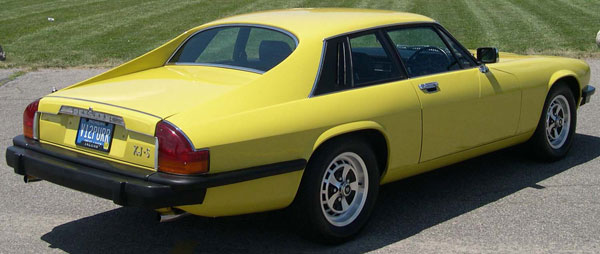 Pre-H.E. XJS. 1976 to 1981 with UK lighting (no front sidemarkers)--always available as a coupe.
This first model affectingly named "preHEstoric" by David Cleary, however we call it the pre-H.E. Only available as a coupe with either a manual transmission or automatic gearbox. Soon the manual was dropped. Extremely quiet and smooth at speed the XJS is the perfect touring car.
Special variants Cannonball Edition
1982 - 1991
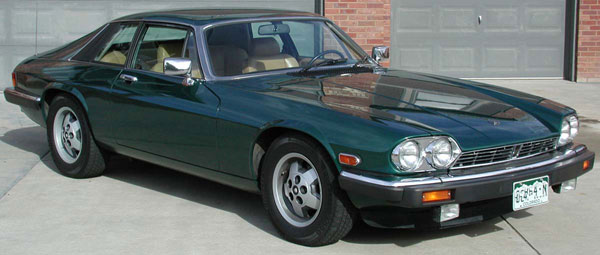 H.E. Coupe 1982 to 1991 US lighting.
For 1982 John Egan gave Jaguar customers what they wanted by adding wood trim to the interior, more leather everywhere, chrome trim on the bumpers and windows, better fuel mileage and increased the speed. Swiss engineer Michael May's "Fireball" combustion chamber, lean fuel mixture, high compression design increased fuel mileage by 20% along with a higher rear gear ratio, higher compression and better fuel management. This model is known as the H.E. for High Efficiency. A cabriolet became available.
 H.E. Cabriolet 1986 to 1988 US lighting.
An inline 3.6 liter six cylinder with either a manual or automatic could be had. A convertible was produced bringing an end to the cabriolet model.
 H.E. Convertible 1989 to 1991, continued with facelift model.
TWR Racing, not missing a beat, applied their winning Touring Car fame to an XJS street car for the owner who wanted a faster firmer XJS. You could pick from a menu or have it all in any XJS available including your car, 6 or 12 cylinder. This lead to the partnership with Jaguar on the XJR-S.
 JDHT cars, front to back: TWR Group A, preHE, last convertible, Daimler Coupe, last V12 coupe.
Special variants H&E, Celebration, Le Mans, Collection Rouge, Collection Classic, XJR-S
1992 - 1994
In 1992 a complete reworking of the car became the Facelift model. Different lights, most noticeably the rear, a new grill design, a change to the rear quarter windows, elimination of door vent windows and a round fuel filler door on the coupe. The interior received new round instruments with wood surround and color keyed dash. The six cylinder was increased to 4.0 liters. The V12 was soon increased to 6.0 liters.
Special variants XJR-S, Insignia
1995 - 1996
 New Convertible 1995 to 1996 US lighting
Lastly in 1995 the New XJS model completed the line with body colored front and rear bumper covers and 16 inch alloy wheels. Manufacturing ended in 1996 with 115,413 produced.
Special variants Insignia, Celebration
Tuners and Customs
Over the years many Tuners, Customizers and Conversion companies have modified the XJS to make it look better, go faster and have more room inside. Some of these include: Lynx Eventor, Turbo and Convertible, Lister and Lister Le Mans, PBB Monaco, TWR (of course), Appleyard Special edition, Guy Salmon Special Edition, HandsHyper, Koenig, Arden, Hess & Eisenhardt for Jaguar Cars Inc.
An XJS won the North American Trans-AM manufacturers title in 1978 and the Group A manufacturers title in the European Touring Car Championship in 1984.
One event an XJS set the record for was the Cannonball Run. A non-stop (except for gas) crossing of the US from the Atlantic Coast to the Pacific Coast run five times. In April 1979 Dave Heinz and Dave Yarborough won in 32 hours and 51 minutes (about 87 mph) beating many models of exotic and modified cars and trucks, a record that still stands. Giving rise to the Cannonball Edition.
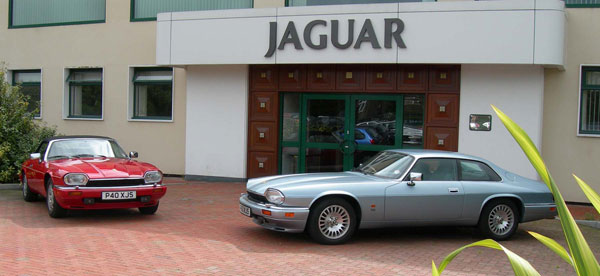 Last two XJSs.
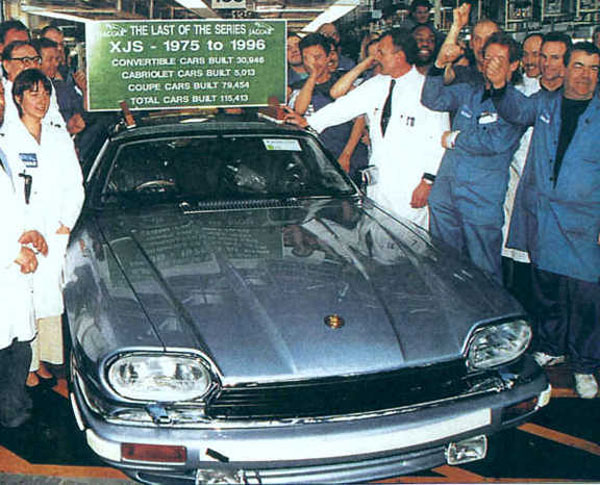 End of the line.
You may leave a comment or question about this article:
2007-10-10 21:04:41 | Anonymous writes:
Why do all the pics. I see of a Cabriolet, show it as a full convertible? Mine isn't. It has two removable panel above the driver/passenger, a centre "roll bar" and a drop down canvas rear portion.
2007-11-04 21:22:14 | Bob writes:
The smoothest car. A head turner thru all the neighborhoods I drive. 94 XJS Convetrible Oyster with Brown top... I consider the color gold/champagne with Brown top
2008-05-25 01:00:52 | Clive Collins writes:
The picture of the "Cabriolet" is actually an H&E conversion car not a cab. You can easily spot an H&E car because it is a modified cabriolet and has quarter lights in the front door glass. The later factory convertibles had one piece door glass. BTW The cabriolets were made by Tickford of England converted from a standard coupe.
2008-07-08 06:42:34 | simon cooksey writes:
Hi everyone, I have been looking to buy an XJ-S and have been offered an 'insignia' model. Can someone fill me in on more detail exactly what this model was? Thanks Si. This will be the second XJ-S I will have owned, already having a 1980 white early rubber bumper model. My daily driver is a V8 XJR, so I love my Jags. Cheers Guys
2008-09-05 17:27:03 | bleasie writes:
To Clive,
Only about 150 of the 5014 Cabriolets were made by Tickford.
They were taking too long to Complete in some cases over a year between Trim date & Comp date.
so Jaguar started to do them in House.
2008-09-14 03:44:38 | bleasie writes:
As you say why do people claim they have a Cabriolet when it is in fact a Convertible.
It seems to be the norm in the States, like wise Jaguar never ever made an E type Convertible.
There are currently about 20 so called Cabriolets for sale but at the end of the day they are not.
Bleasie International Cabriolet Register
Jaguar Cars Approved.
If you have one please get on touch.
we need to find the missing 35.
2008-10-05 17:23:21 | bleasie writes:
Having just got back from JDHT updating their Data Base.
To my surprise I had to remove details supplied by Owners whose cars were in fact COUPE's
How do you mistake a Coupe for a CABRIOLET??????
2009-01-06 14:13:33 | Dawn writes:
I own a Jaguar 1978 XJS Cabriolet and yes it is a cabriolet (a soft top with a roll cage) and not the coupe (hard top) but its approximately 5 years before Jaguar brought out a cabriolet. I know that Lynx did a Jaguar XJS convertible in 1978 the spider but this is a true convertible (soft top minus roll cage) did Lynx also produce a cabriolet version or were their conversion kits to convert to cabriolet or convertibles or were both options available? I also know another company Crayford were also doing XJS convertibles did they also do cabriolets. Mine is a very professional conversion and would like to know its history. Dawn
2009-04-15 17:48:31 | Larry Gaughan writes:
I now own my dream car A xjs 2+2 convertible.
2009-04-19 10:09:57 | XJS AND ME writes:
I'm 70 Y/O.
I've owned more cars than I can remember.
Presently, I own a two seater '93 XJS convertible in 4.0 6.
It is a metallic black cherry which shows as a deep purple in bright sunlight.
It is absolutely the smoothest and most elegantly beautiful car I have ever owned.
I will ALWAYS either keep this wonderful ride or another like it.
I did add a rear spoiler on the trunk lid and, it came with Dayton wire wheels.
I'll be looking for one of those small motorcycle trailers to tow with it as, there is very little trunk space and, those trailers tow as if they're not there and are great for trips.
This big cat lives in the garage here in the ugly WI winters.
2009-06-21 13:48:26 | Mike G writes:
I have had 30 Cars and 1 SUV. Two of the cars were 1969 XKE convertibles (God, they were great cars) and one was a 1968 XKE coupe. The 31st is a 1994 BRG 4.0 XJS convertible and I love it. It is absolutely beautiful, fast and comfortable. Everywhere I go I get smiles an compliments - great car.
What I don't understand is why they are soooooo affordable. I bought my 94 on EBay for $8,500.00 with only 47,700 miles on it, and it runs like a top. Whenever I look, there are at least a dozen XJS coupes and convertibles up on auction and most are between $3,500.00 and $9,000. I think that any XJS is a great investment and the cars produced after Ford took over are just as reliable as any other car for the age and milage.
When do you think that people will begin to appreciate just how great this model is and when we will see the prices atart to approach XKE territory?
2009-07-10 15:05:33 | dux writes:
were forgetting Hess and Eisenhardt here...they were in this cabrio mix..........the best of these in the us werethe 94-6 sixes,for handling and reliability...i had met geoff Lawson and have been credited with persuading them,with contacts i had,in 91 ...to do this......vs the w107 sl's with sixes,natch....also the inspiration for the car,such a mystery..isnt ...in the best lyons tradition: its a kooler version of a Lambo 400..
probably Touring related....love to hear from folks...love em.!.like the XK 150,the smart mans Aston equal.....
2009-09-20 13:23:52 | Patty writes:
I own a 1988 XJS V12 Cabriolet. The front 2 hard tops lift out leaving the back hard top in place. The front two stow nicely in the trunk. The back hard top can also be removed for a complete convertable.
2009-09-22 00:50:30 | Martin Snytsheuvel writes:
Who in the world could not appreciate the XJR-S oor the wilder Lister XJS?
2010-01-02 19:34:10 | Erick writes:
I have a 1987 Hess&Eisenhardt V-12 convertable how many where made and how many are still on the road.
2010-01-21 00:57:02 | Donna writes:
I am looking to put sidepipes on my 1988 Jaguar XJS 5.3 and I was wondering where I might buy sidepipes that would fit. I find alot of sidepipes for Corvettes but no one seems to offer this modification for the XJS, it is though our lovely Jaguars don't exist. Sincerely, Donna
see my XJS on here when the moderators post it.
2010-02-19 07:19:58 | Bleasie writes:
Patty writes:
I own a 1988 XJS V12 Cabriolet. The front 2 hard tops lift out leaving the back hard top in place.
The front two stow nicely in the trunk.
The back hard top can also be removed for a complete convertable.
Where are you Patty get in touch jag92hot@aol.com
2010-02-23 17:40:52 | mike writes:
i to have owned many many cars in the past,lots of muscle,lots of imports. but i have owned a 1990 xjs convertible for 5 years now, and nothing else compares. im in my fifties now and this car has it all elegance style, beauty and power and grace. it gives me great pride to own it and many complements by everbody. when i was younger i would watch this old italian guy drive his masseratti around town, he was stylish and elegant and would always wish i could someday have a car and just cruise around on a sunny afternoon. my jag xjs is my dream come true. i purchased it from a drs wife who had grown tired of it. i offered her half of her original asking price. she at first turned me down but some months later called me and accepted. it has had alot of required upkeeep done and ive spent some dough... but its the best five thousand i ever spent for a CAR!!!!!!
2010-03-30 16:39:54 | Roy writes:
I have now two of these briliant touring cars! one of them i drive from time to time and the other one is
my restauration project! they are buildt in 1978 and one of the cars if fitted with a TWR bodykit! Wich makes her less old than my other car with the standard black bumpers! I do maintanence myself so i have the time, and the patience to work on the cars! and time you will need to maintain them in a good way!
2010-07-24 12:41:44 | Robin writes:
Bleasie,
You mentioned you were missing 35 Cabriolets for your registry - I have one, it's a 1986 XJ-SC Cabriolet - yes it's a Cabriolet. I'm actually looking to sell mine because I'm relocating and besides it's just been sitting in my garage for the last cpl of years. Anyway if anyone is interested email me ryeung2@verizon.net
Robin
2010-08-04 06:03:17 | Anonymous writes:
Hi Dawn,
I have a 1976 XJS Manual Cabriolet by Lynx - pretty rare I suspect?
Peter
2010-08-22 05:36:54 | Roger writes:
From Bleasie:
Have been doing some research in Archives Not sure but you may have all this
2W/1001 Lavender / Dark Blue trim 1st XJS RHD
2W/50001 1st LHD
2W/1002 Signal Red / Russet McCormack Race Car
2W/1007 JVC 485 N Auto Car Test Car
2W/1019 JVC 10 N Brochure Car
2W/1075 TV Series New Avengers Gambits Car
2W/1138 The Saints car (ST 1)correct Reg# PWK 530 R
2W/1154 Gold Sorrel Earls Court 1975 special paint by Carrs paint Ltd Birmingham Sorrel trim by Austin Motors
2010-09-12 17:33:33 | barry moss writes:
I HAVE 1989 V12 JAGUAR COUPE. i have trouble starting when hot / CAN ANY SUGGEST ANY THING/ THANKS
2010-09-27 07:19:22 | Lmuzza writes:
First thing to check for hot start problems is the ignition amplifier- best bet is to replace with Crane XR700 ignition, quite cheap & very reliable. I have white 1977 XJS vin 2w3318BW on lpg.
2010-10-06 19:03:50 | Gail writes:
I have a 1995 xjs coupe 4.0 6 cyl. I read that there were only 364 made. How can I find out if this is one of those cars.
2010-10-09 12:34:46 | Phil writes:
Gail,
Yes your car is one of those. I think the number may be a bit higher...but definitely less than 800....I seem to recall " just under 700."
1996 Coupes are even rarer, as there wasn't even a full year of production...and 96 V-12 coupes were special order only.
2010-11-11 09:21:11 | Miles writes:
Greetings Barry,
I don't wish to disagree with Lmuzza but I think I would begin with the starter. It sounds as if it becomes "heat soaked" when the motor shuts down. This will occur if the starter is on it's way out, the windings are separating internally. Also make sure the heat shield(s) around it are intact. The starter motor is against the block, (obviously) and the starboard exhaust Cats run directly next to it. When you shut off the beast all the accumulated heat saturates the engine compartment This happened to me last year, not frequently but within a few days I was stranded waiting for a flat bed to take my ride home. I ordered a high torque upgrade unit developed for the 6.0L. More costly but well worth it. It's half the size and really whips the V12 over. The original was huge and a two hour job to change. As a test, as soon as you leave the drivers seat just open the hood for awhile. If she stops being temperamental when the heat is vented then that will be your issue. Then go order the starter. (Around 200.00 last year.).
Off topic, have you a copy of “"Experience in a Book: Help for the Jaguar XJ-S Owner" by Kirby Palm. It is a free, 700 page living document many years developing. Mr. Palm and his associates can be found at WWW.Jaglovers.com. If your not a member please check it out. Great people all round. Good Luck...
Cheers,
Miles
2010-11-11 09:24:26 | Miles writes:
Donna my dear,
Are you still searching for your side pipes? We spoke a year age on the subject and I told you We XJ-S owners typically have issues finding specialty items for these beautiful machines. We adapt, develop and perceiver by making our own or modifying something made for another vehicle. We overcome and soldier on.
Try this, check the net for a outlet that handles "Purple Horneys". They are a four foot long, 4" diameter, flanged muffler with a side turn out. My brother used to run them as side pipes on a 1940 Ford Coupe. They can be customized to look nice and the sound is impressive. Once again, good luck...
Cheers,
Miles
2011-01-10 08:40:43 | Rick writes:
I am the proud owner of a 1995 4.0 Coupe in Carnival Red with Ivory Leather. I live in Bahrain and I have only seen one other XJS in the whole country (albeit a small one!) its a 1987 model white.
I have two questions, 1. I am not sure whether to sell her as I have been offered a much higher price than what i paid for her. It seems that if Phil is correct and there were a small number of this particular model and year made, then it may be worth hanging on to? What do we think people? I must admit I am very fond of her and she turns heads even at the Ritz LOL
2. The elegant Lady has sagging headlining and I am waiting for a quote to come back from the local Jag Dealer (Mohammad Jalal) am expecting some huge quote lol. also the housing for the front right headlight has been broken..
Is it a viable idea to order from the UK (where parts SEEM to be cheaper) and get the local Jag dealer to fit them?
Thanks in advance guys.
Cheers
Rick
2011-01-14 05:42:47 | Dave Jones writes:
I own an XJ-SC 3.6 manual. 1985 with genuine 79k miles. How can I find some info, as to what production model, which showroom it was first sold from, can I find previous owners, etc. Dave.
2011-01-14 09:15:31 | Anonymous writes:
Dave,
Someusefulsites foryouto look at mate, especially the last one which has specific info on the XJ-SC
www.jag-lovers.org/
www.jaguarforum.co.uk/viewtopic.php
www.xclusively-jaguar.co.uk/xjsc01_index.html
Rick
2011-04-13 18:05:02 | dave writes:
I have owned a 1988 xjs-c with 50,000 mi. for 4 years. A true cabriolet. Front two targa panels come out as well as the rear hardtop section leaving the rear windows and targa bar.I drive it in good weather with all tops off as I can only store the two front panels in the trunk.I love it and it gets a lot of attention.
2011-04-13 18:15:00 | dave writes:
p.s. it is a 5.3 v12 Also there is no back seat, just stowage areas.I believe the only way it was allowed into the U.S. was to remove the rear seats.
2011-05-27 23:22:37 | zach writes:
Hey guys i was thinking of buying an 87 xjc coupe with 88 thousand miles im here in northern california its about 2200 dollars for my first car and wa swondering if you could give me any tips about owning one ive read the whole jaglovers page on the xjs and ive fallen in love with them
thanks, zach
2011-08-27 01:51:11 | Bleasie writes:
Hi guys may I point out that web Site listed above by RICK
xclusively etec etc is not the official Web Site for the XJ-SC it is a bogus site created using mine & Rogers Data
the web Site associated with XJSDATA is WWW.JAGICR.ORG which now has 181 active members in 17 countries . There are Several links on this site that will take you to the correct place
Regards
Bleasie
www.jagicr.org
2011-08-27 04:13:41 | Bryan writes:
Hi being a cabriolet owner for nearly 18 years and the owner of a very well known concours car i can honestly say the only club site to be with is www.jagicr.org with 181 members most of which own cabriolets from all over the world just go to our webb page and see what we have in store We also arrange lots of events in the summer Months next year marks the 30th anniversiary of these fantastic cars and we already have a venue planned So what are waiting for if you have an xj-sc please vist our fantastic site THE TRUE HOME FOR ALL CABRIOLETS we will only be too pleased to have you join us kind regards Bryan Thomas XJ-SC 3.6 841 BRY Mutiple concours champion
2011-08-27 04:34:15 | Bleasie writes:
Thanks Bryan
as you say www.jagicr.org is the only home for Cabriolet owners
go to BLOGS & you will find 12 months Back issues of Mean & Roofless the Monthly News letter for Cabriolet Owners
Regards
Bleasie
www.jagicr.org
2012-01-26 03:33:43 | Rick writes:
Hello all,
Following on from my last post back in October last year. I wanted to update you with regards to my 95 coupe.
I managed to source the headlining - along with the two front seats - re-covered here in Bahrain for a pretty cheap price of $265 dollars.
I am now looking for a front bumper assembly as mine has cracked at the bottom and is damaged.
Anyone got any ideas?
Also planning to sell her as well in the coming months. I am reluctant, however there is a war brewing and I don't want to have any ties here!
Cheers
2012-05-10 18:16:52 | greg writes:
great car my first and now last cause the xjs 12 is a special car ,,, most dont understand or care too so i win!
2012-05-31 17:50:57 | Graham Greenwood writes:
Check out the new XJS Club, where the car is the star, UK £10 lifetime membership, no annual charge!
www.xjsclub.org go there now!
2012-06-11 20:53:21 | harry writes:
Read everything about XJ-S V12 maintenance
jaguarslover.blogspot.com/2012/02/xj-s-v12-maintenance.html
2012-06-14 15:24:59 | Harry writes:
Read everything about XJ-S V12 maintenance
jaguarslover.blogspot.com/2012/02/xj-s-v12-maintenance.html
2012-08-17 03:18:01 | Andy writes:
hi - all - have recently purchased an interesting xjs convertible , built by arden and ordered ,i believe , new from jaguar by Duncan Hamilton the 24hr le mans driver.
can anyone tell me how to upload photos to this site,as i am seeking any info on this car.
many thanks
2013-09-29 04:57:48 | Nikkii writes:
Hi there I wondering anyone can help. Sadly due tobiz father passing away my friend now owns a jaguar xjs lynx with a turquoise Gucci croc skin interior. His dad was a real collector and said it was one of only 20 made and only 2 in the country. He has no idea what to do with it or what it's worth can anybody help or point us in the right direction. Thank you
2013-12-02 15:02:11 | Justin writes:
Also the Koenig specials which 14 were built according to what I've read.
2014-11-27 06:48:13 | Richard writes:
I'm in the UK and I have a 1989 (yes 1989!) XJSC cabriolet no SAJJNAEW3BB158061, which shows that it started life as a coupe. I guess that it must have been converted from a coupe by one of the UK specialists, because it is indistinguishable from the factory model in every respect, down to the smallest detail. Perhaps it was a special order after the end of Cabrio production?
2016-11-26 02:47:31 | Anonymous writes:
Hi,
Great site!
One correction, in the U.K., Australia, etc., the body coloured bumpers and 16" wheels were introduced on the mid 1993 XJS model, not 1995-1996.
Perhaps it was 1994-95 for the North American market.
2016-12-20 21:17:00 | Chris Leeson writes:
I am the owner of a 1992 4.0l XJS-C full targa top and hood cabriolet.
The car started out as a 4.0l Coupe in diamond blue and was converted to a cabriolet not a convertible in 1996 by Paul Banham using all genuine jaguar parts and materials.
The car is in excellent condition and looks stunning, attracts loads of attention at shows as it is undishtinguishable from Browns Lane produced cars.
If anyone knows of any other such models I would love to hear from Them
Regards,
Chris Leeson
2017-01-30 05:15:31 | Dennis Dudley writes:
I have a true XJS-CABRIOLET I'm in search of a owners manual or copies of the attachment of the rear hard and soft tops..
Can anybody help I'm certain my car is missingsnaps and brackets.
Dennis
Vettewagon@yahoo.com
2017-05-14 15:39:17 | doug writes:
On my 1995 jaguar XJS - what is the difference between the green and black car keys?
2017-10-16 03:16:18 | chris writes:
the green key i was told was for valet parking, was limited access to the car.
2017-10-26 08:28:40 | Laurence writes:
The XJS Soft Tops Club is for owners and enthusiasts of the various XJS Cabriolets and Convertibles, whether built directly by Jaguar or converted by a bodyshop.
The website also incorporates the International Cabriolet Register
www.xjs-soft-tops.com
Laurence
2018-06-12 20:28:47 | Carlycarl writes:
My name is Geron Decker. I'm super joyfull that I signed up on this site. I have been searching for this type of expertise knowledge for a weeks and have discovered what I was studying for. I am a web graphic artist and internet marketing professional and have been ,building sites for the last 11 years. I can put your sites at the top of the search google quickly for any Keywords you need and is something I can provide for you if you have a site or a product you are marketing. I can also help you with your website if you need to redesign. If you have any questions or comments,by all means feel free to text me anytime 520 585 0384. Best regards, Geron Decker. P.S. Thanks for letting me post this to your blog! By the way I am a musician in hotels and resorts and fine restaurants. If you want to see me play a song check out this video:
www.yourepeat.com/g/sabicas+bulerias+%27con+un+clavel%27 or Phoenix seo companies
2018-06-13 06:07:43 | Carlycarl writes:
My name is Geron Decker. I am really amazed that I discovered this site. I have been dreaming for this type of noumena for a hours and have found what I was looking for. I'm a web designer and internet engineer product and have been ,making sites for the last 13 years. I can put your blogspot at the top of the search google fast for any Keywords you desire and is something I can help you if you have a site or a product you are marketing. I can also help you with your social marketing if you need to redesign. If you have any questions or comments,by all means feel free to text me anytime 520 585 0384. Best regards, Geron Decker. P.S. Thanks for letting me post this to your site! By the way I am a musician in hotels and resorts and fine restaurants. check out this video www.youtube.com/watch
or Phoenix seo companies
2018-06-13 17:37:54 | Carlycarl writes:
My name is Geron Decker. I'm super glad that I came across this website. I've been looking for this kind of stuff for a hours and have discovered what I was trying for. I'm a web graphic artist and internet engineer product and have been ,making websites for the last 10 years. I can put your site at the top of the search results quickly for any Keywords you need and is something I can do for you if you have a blog or a item you are marketing. I can also help you with your site if you need to make any changes. If you have any questions or comments,by all means feel free to call me anytime 520 585 0384. Best regards, Geron Decker. P.S. Thanks for letting me post this to your site! By the way I am a guitarist in hotels and resorts and fine restaurants. check out this video pplcrwlr.it/about/gerardo/geron/
or Phoenix seo companies
2021-02-19 13:30:21 | marco writes:
How many XJS 6.0 V12 cabriolet were built?
2023-07-19 20:48:55 | John Belcher writes:
Hi
just bought a 1996 XJS Celebration. Anybody know how many were made and how many in the states?
Gonna be a hoot
Thanks
John